
Transform a strip of lawn into a wildflower meadow, providing butterflies and insects with shelter, nectar-rich flowers, and locations for pupation or overwintering.
Procedure:
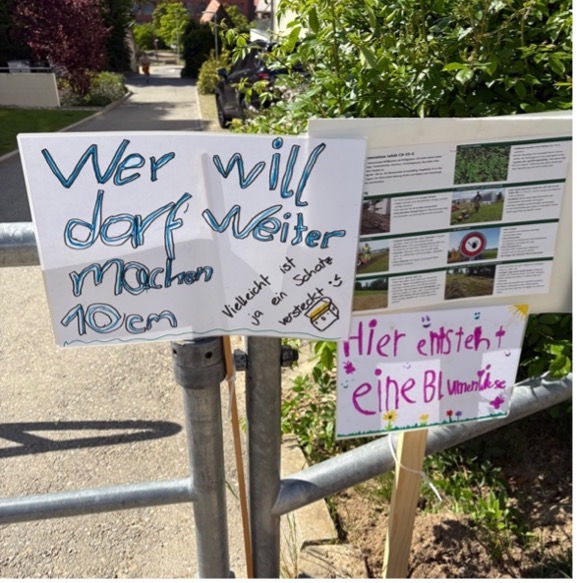
After the administrative work such as permits, research, and gathering detailed information was completed, the grass wasteland was worked on with the groundbreaking ceremony on Friday, May 8th. The location is very sunny, was still being fertilized until last summer, and therefore it was decided to remove 10-15 cm of turf.
What a pain, as it hadn't rained for days and the earth was as hard as a rock. We made correspondingly slow progress and only through exhausting backbreaking labor. The result at the end of the day was somewhat depressing...
Nevertheless, the students were fully engaged and thrilled to spend the afternoon a bit differently. The public works yard provided us with the necessary spades, wheelbarrows, and a dumpster. The custodian, who wasn't very enthusiastic at first, even gave us tips and checked in on us from time to time.
How were we ever going to manage that? 1 hour of hard work and only a small part of the turf had been removed. Perhaps the poster we had designed would help? Or maybe the weather would turn in our favor.
And we were lucky, because then the wet spell followed, and the earth softened up completely to a depth of about 20 to 30 centimeters. We shoveled and shoveled – on Tuesday, May 12, the students even skipped gym class to make progress. In the meantime, students from other classes also joined us from time to time and pitched in. The rain didn't stop us!
After 4 hours of work, the property already looked completely different! Just 2 more hours and we would have accomplished the first step.
After the initial tillage, the soil should be left to rest until sowing.
On June 1st we will sow the seeds. We are using the seed mixture from Landi-UFA Wildflower Meadow Jubilé CH-55-G, which features many native wildflowers and wild grasses with an extremely high proportion of flowers. The growth height is 80-100 cm, with the main bloom in May and a second bloom in August. The meadow would provide food and shelter for numerous insects and small animals.
First, we will work the entire surface superficially and break up the crust a bit with rakes. Then, the seed is sown by hand in two operations: once lengthways, then crossways. Finally, we will carefully roll the surface with a lawn roller.
Wild herbs then take 4-8 weeks to germinate. Neither watering nor fertilization is permitted. After 8 weeks, the first cleanup cut is done so that the soil conditions are ideal. In the year of sowing, almost only weeds are visible and the appearance takes some getting used to. Only after the first winter, i.e., in the second year, can we enjoy the colorful and beautiful wildflowers.
Butterflies instead of green deserts!
Herbs and flowers instead of lawn.
Habitat for insects!
Wait and see, acquire humus-rich soil, plow (the ground is very hard, especially when there is little rain), obtain permits, seek and maintain good communication and cooperation with the public works yard.
Mechanically remove existing lawn area, possibly plow, rake, soil, seeds, sign.
Mechanically remove existing lawn area, possibly plow, rake, soil, seeds, sign.
As the «oldest students in the school,» the class demonstrates how a sustainable, nature-inspired idea can be put into action. Everyone pitches in—they roll up their sleeves and get to work!