
School garden
Cycles 1 and 2
St. Antoni Primary School
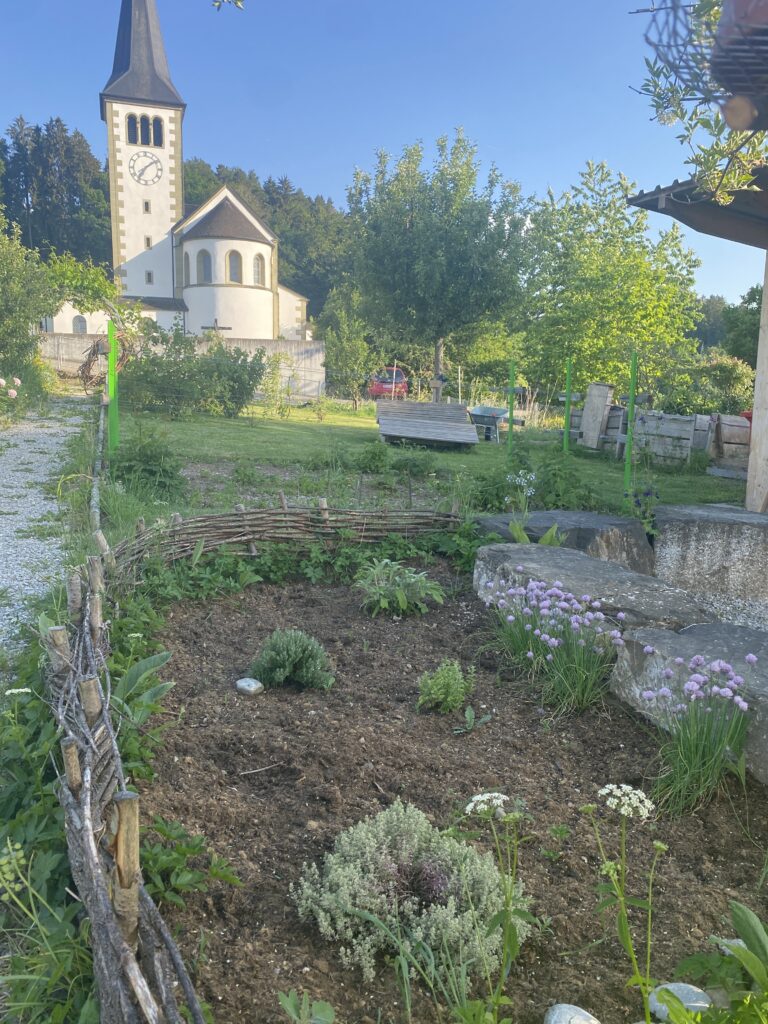
For several years now, there has been a school garden at St. Antoni Primary School. What began with a few herbs has grown over the years into a fairly large and central project for our school. By planting and tending their own garden beds, the children can gain experience and knowledge in „Education for Sustainable Development.“ The ideas are continuously adapted and linked as best as possible to Curriculum 21.
At our school, it is a place of learning, working, observing, sustainability, togetherness, peace, enjoyment, and during hot summer days, even an additional classroom. In our school garden, you can find a wide variety of flowers and plants, berry bushes, grapes, and fruit trees.
The following projects are currently underway.
Sponsored flower beds
Each of our 6th graders has a kindergarten buddy. Together, they tend to the strawberry beds and deepen their relationships in the process.
Photosynthesis
The high school students take care of the asparagus bed and learn about the process of photosynthesis.
school break snack
Carrots, radishes, various types of berries, grapes, apples, and pears are handed out during the weekly school morning snack. Every Wednesday, fresh bread, fruit, and vegetables are delivered by a farm shop from the village. Taking turns, one class at a time prepares a healthy and waste-free morning snack for the other children.
cycle of seeds
The tomatoes are grown from seed by ourselves in February, pricked out, planted and distributed, and new seeds are collected again in autumn for the upcoming season.
The lower grade children do the same with the pumpkins. Only we always buy new seeds there. From the pumpkins, the children make a soup that is served at the parents' evening.
The sunflowers are planted by the youngest and are simply beautiful.
From grain to bread
For example, last summer the 4H class was able to harvest the spelt that had been sown in the spring by another class. The children threshed the spelt by hand, ground it into flour, and baked bread. Afterward, with the help of a farmer, they sowed and cared for new grain, this time wheat. Now, another class will be able to harvest and process the wheat this summer.
generational project
With residents from the neighboring nursing home, sauerkraut will be made from self-grown cabbage.
So…
...producing and enjoying tea and herbal blends with herbs from the school garden,
...to have a delicious lamb's lettuce salad and potato rösti together for lunch
... observations at the infertile meadow, the wild bee hotel, and the earwig hotels
... observations around the compost
… Various flowers
... Corn Popcorn
The competencies of Lehrplan 21 can be developed in a very hands-on way through our school garden. The children experience the processes of nature up close and participate actively themselves. From sowing and weeding to harvesting and processing—the pupils can experience it all firsthand.
Benefits for the environment
We believe that Education for Sustainable Development cannot be taught solely in the classroom and want to show that environmental protection can be communicated not only through sacrifice, but also through pleasure and joy. By producing seasonal and regional products, among other things, we want to critically question consumption patterns and create options.
In our school garden there is a lean-to meadow. In addition, many insects find a home in our insect hotel. We use neither pesticides nor fertilizers.
Challenges
The effort required to keep a school garden of this size running is immense. Watering the various crops in particular is a challenge, especially during the weekends or over the summer holidays.
Teachers must have the courage to try out projects in the garden and [realize] that you can start fresh every year. Sometimes things work out, and sometimes, unfortunately, they don't. (Snails, drought, hail, frost...)
- a school garden working group that will take over the management of the school garden and serve as contact persons for all questions related to the school garden.
- Schedules for who waters and harvests when.
- Permanently include the work/projects in the annual plan.
- To be able to implement a project of this size at a school, all teachers must pitch in and support the project.
Material
- Tooling must be repaired or replaced.
- Seed
- Furniture: tables and chairs as learning environments for written work.
- Parasols
Costs
- Tooling must be repaired or replaced.
- Seed
- Furniture: tables and chairs as learning environments for written work.
- Parasols
That is what makes our project special
Our school garden demonstrates that sustainability is not just a word, but something we can actively shape ourselves. We plant, tend, observe, enjoy, and learn in the process: I can make a difference.